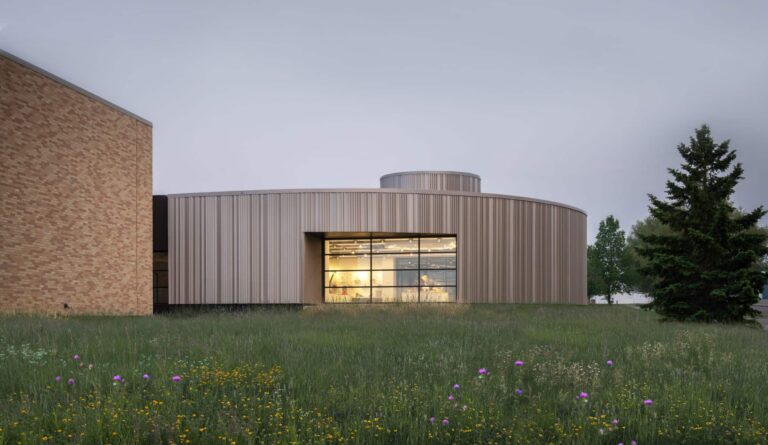
Nobody appreciated taking a seat to take in the view more than Theodore Roosevelt, especially in the Badlands of Medora, North Dakota. In fact, he wrote of his fondness for rocking chairs in his 1885 book, Hunting Trips of a Ranchman, asking, “What true American does not enjoy a rocking-chair?”
As Architect of Record for the Theodore Roosevelt Presidential Library (TRPL) in Medora, JLG Architects’ Interior Design Studio, led by Senior Interior Designer Jessi Larson, NCIDQ, LEED AP, WELL AP, partnered with Snøhetta for the monumental task of hand-selecting and designing furnishings worthy of residing in a historic destination — a place credited with catalyzing America’s conservation movement.
Of the Earth
In the rugged terrain of the Badlands, the team’s design inspiration came from the earth — choosing natural form, textiles, and patterns shaped from a wild west wonder of dramatic buttes, steep canyons, colorful clay formations, and striking rock outcrops.
At the TRPL, the selection of furnishings went beyond surface-level aesthetics, weaving together a curated collection of sustainably built, handmade pieces, reclaimed wood, and high-performance materials aligned with the project’s ambitious environmental certification goals.
“TRPL is set to achieve three concurrent certifications at the highest level, including LBC, LEED Platinum, and SITES Platinum,” said Chayna Claeys, AIA, LEED AP, LFA | JLG Sustainability Manager. “Once the LBC performance period has commenced, TRPL will be a ‘living’ building and brilliant example of energy independence – making more energy than it consumes.”
Wild West Furniture Fairs
To ensure the Library embodied the conservation values Roosevelt first championed, JLG worked closely with Snøhetta—the project’s International Design Architect and Design Landscape Architect—on design, research, coordination, and the orchestration of two large-scale furniture fairs. For the fairs, nearly 40 furniture samples were sourced from across the country — everything from stage seating and task chairs to outdoor rockers and indoor occasional tables.
The first fair was held in JLG’s downtown Fargo office in the spring of 2025. The second followed that summer at Eagle Ridge Lodge, a stunning TRPL property overlooking the Badlands. This hands-on, highly collaborative process was instrumental in securing buy-in from both the Owner and Construction Committee. Together, the team prioritized sustainability verification and transparency in material selection for both carbon and human health impacts. Altogether, JLG vetted over 29,776 building products to confirm they were free of “Red List” chemicals.
TRPL made sure local leaders were deeply engrained in the process to help our team arrive at the best solution for their vision and success. Eileen Scheel of Fargo, ND, led TRPL’s Board Committee on Architecture and Construction; gaining her approval was a key part of the design process long before furniture was on the table. In addition, Ken Vein and Tony Erickson, TRPL Staff responsible for design and construction, leveraged their large-scale and complex experience in construction to keep owner decisions on track and solutions aligned with long term operational success.
Well-Crafted Collaborations
From the time furniture design and selection efforts kicked off in the fall of 2024 to installation on May 18, 2026, the project team continually pursued Living Building Challenge (LBC) certification — one of the most rigorous sustainability standards in the world, achieved by only around 40 buildings globally.
While all TRPL building materials underwent LBC review, only higher-quantity furniture—private offices, workstations, and task seating—was subject to compliance.
“Although the furniture industry is still catching up to the building sector in terms of sustainability and transparency, we were able to identify products that meet both LBC requirements and the design vision,” explained Larson. True to Roosevelt’s spirit, much of the furniture is proudly manufactured in the U.S. True to Snøhetta’s Norwegian roots, they incorporated select Scandinavian classics from Audo Copenhagen, Arper, Mater, Muuto, and Andreu World.
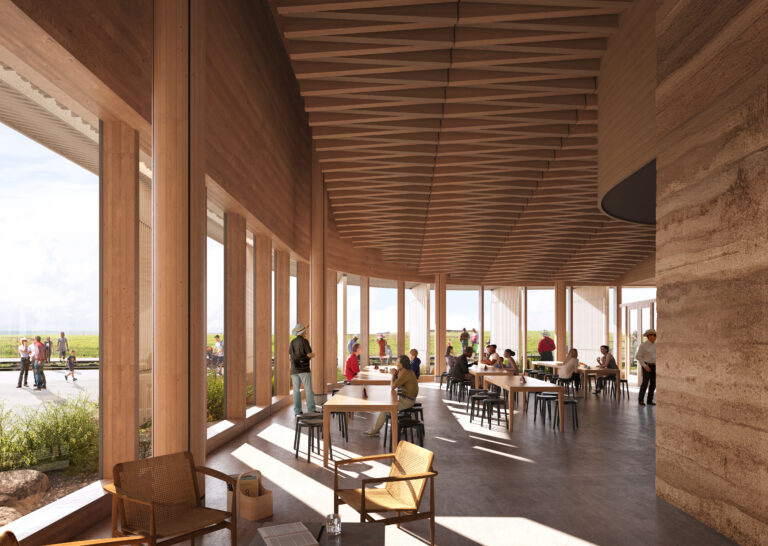
In the TRPL Café, the team chose highly sustainable Mater Compound chairs. These Danish-designed pieces by OEO Studio are made from a patented Matek material that blends coffee shell waste, wood waste, and upcycled e-waste.
Meet Marco
Within the broader furniture landscape are truly special rocking chairs designed and handcrafted by master woodworker Marco Bogazzi, who operates a small studio in Portland, Oregon. Each chair was built from solid wood with remarkable care and craftsmanship.
“I remember being on my bike commute when Jessi’s message popped up; as soon as she mentioned it was for a new Presidential Library, I had to stop,” said Bogazzi. “These are my favorite projects because they allow our work to be enjoyed publicly, and I welcome the opportunity to create pieces for a broader audience. I also enjoy the challenge of balancing aesthetics with the durability required for heavy commercial use.”
Before JLG learned of his studio, it was Craig Dykers, co-founder of Snøhetta, who had discovered Marco’s Onda rocker, which was originally designed in 2021 — described as a ‘modern, contemporary outdoor chair intended to be warm, cozy, and timeless.’ This chair started as a sample debuted at last summer’s furniture fair and quickly became a favorite among TRPL leadership, Snøhetta, Fluid Interiors, and JLG alike. Jessi requested an initial sample, then asked Marco to produce several rounds of prototyping for review in Fargo and at Snøhetta’s NYC office.
Just like T.R.’s bold journey, Marco saw the risk and understood there was no guarantee of winning the team’s favor, but ultimately, it was work worth doing. Marco’s rockers—Roosevelt’s favorite style of chair—now rest in the Library’s open-air Breezeway overlooking the majestic Badlands. “They are built using thermally treated ash, a chemical-free innovation that allows domestic USA lumber to endure outdoor environments as well as Burmese teak,” explained Bogazzi. “Unlike teak, thermo-ash is sustainably harvested and significantly more cost-effective. The wood is a beautiful natural brown with no stain or finish; over time, UV exposure will turn it a maintenance-free silvery-gray.”
Workmanship Worth Doing
For the construction, Marco’s team used traditional mortise and tenon joinery reinforced with embedded fasteners. “Each corner is mitered to eliminate exposed end-grain, which protects the wood from moisture and cracking,” he explained. “We fastened removable nylon glides under the rockers to protect the wood from wear.” Since Marco’s team most often produces fully assembled pieces, with no exposed fasteners, both chairs shipped to TRPL fully assembled.
“It was well worth the risk,” added Bogazzi. “Ever since I was a child, I’ve dedicated my entire life to designing products that bring joy to people’s lives, and it is a true honor to have been given this opportunity with TRPL. We made each piece with love and hope our work can in some way contribute to the public’s experience of this amazing place.” Learn more about Marco’s work at: www.marcobogazzi.com
Salvaging the Past
To make history while preserving it, the team integrated salvaged wood from a copper beech tree Roosevelt planted in the 1890s on his family’s beloved estate at Sagamore Hill on Long Island, NY. The tree lived 125 years before its required removal in 2019. Today, thanks to the meticulous craftsmanship of Grain Designs, 15-foot live-edge slabs of the salvaged wood have come home to the Badlands, where its copper beech is on display at the ticketing desks, as donor walls, and artfully crafted into podiums and conference tables throughout the “living library.”
From their woodshop in the rural North Dakota town of Davenport, the Grain Designs team, including Grant Koenig, Blain Mikkonen, Cody Freestone, Zach Nelson, and Pat Bresnahan devoted ten months to the copper beech masterpieces, in addition to a collection of engraved cedar signage. Their team’s work can be found from the cedar trailhead sign to the three “Distinguished Leaders” trio of engraved slabs in the entrance. One is engraved with a T.R. quote while the other two reveal the names of those most impactful to the project, everyone from state leaders to corporate supporters.
Grain Designs received their shipment of copper beech, which had been milled and slabbed, back in August of 2025. “Although it was pretty dry, all three loads of it had to be kiln-dried,” said Grain Designs owner Grant Koenig. “It took around four months before we could get started figuring out what we could do with it. We had architectural drawings of what each piece should look like, but with the live-edge details, a lot of it was subjective and needed to be hand-drawn.”
Grain Designs would spend the next five months working closely with JLG, Snohetta, and JE Dunn Construction, altogether scrutinizing every inch of the Copper Beech’s challenging imperfections.
The hand-built conference table is strengthened by two steel bases connected with steel bars to forge one larger table base. Four sheets of quarter-inch steel are bolted to the base, and four individual slabs were matched end-to-end to create the 22-foot table. What appears to be a river running through the center serves as a functional channel for IT needs and data ports. Grant estimates that the conference table weighs around 1,500 pounds. “That was part of the design challenge – we had to deliver it, then figure out how to get it to the second floor. It had to fit and look like one table, because it couldn’t be done in one piece.”
Grateful to have been entrusted with the historic copper beech, Grain Designs understood the significance. “Getting the chance to do this type of project really brought back a lot of the core values that Grain Designs started with in 2013,” said Koenig. “We wanted to continue to tell the stories of that 100-year-old barn wood; preserving history and using only reclaimed wood; that was a big part of our identity for the better part of eight years until it became a lot harder to get and we had to use other materials. Telling that story has always given us energy, and I don’t think there’s a better example of that than utilizing a tree that Teddy Roosevelt himself planted. Anytime there’s a narrative tied to it, it makes the project so much stronger.”
A tree Roosevelt’s great-grandson once described as a “guardian” of the house, has now become the guardian of his own Presidential Library.
“Theodore Roosevelt believed that worthwhile things require grit and the courage to step into the arena. This project embodied that philosophy every day. Like Roosevelt’s own legacy, it wasn’t built on comfort, but on resilience, determination, and the willingness of countless people to show up, solve problems, and create something greater than themselves. I’m honored to have been one of those hands and to have left a small part of myself in such an extraordinary place that will inspire generations to come.”
Jessi Larson, NCIDQ, LEED AP, WELL AP | Senior Interior Designer, JLG Architects